

Family Governance and the Four Room Model
When families think about governance they tend to think of a Family Constitution. While important, that is not the complete picture. In reality, many families may already have a range of governance structures, documents and processes in place, sometimes developed organically and without deliberate design.
What is governance?
Family governance is the system through which a family makes decisions, exercises oversight, and preserves both its financial and non-financial capital across generations. It encompasses the structures, processes and shared agreements that guide how a family organises itself, communicates, resolves conflict and aligns around common values and goals.
Leading thinkers in family enterprise and multigenerational governance provide useful perspectives.
Dennis T. Jaffe describes effective governance as providing “a roadmap for how a family stays together and makes decisions together,” particularly as complexity increases over time.
Tom McCullough emphasises that governance is not simply about control or compliance, but about enabling families to act intentionally by integrating their values, relationships and resources into coherent decision-making.
James E. Hughes Jr. further expands this perspective, noting that governance should ensure that wealth supports the development of the family, rather than the family becoming constrained by the wealth itself.
Family governance creates clarity around roles, responsibilities and expectations, ensuring that wealth serves the long-term continuity, capability and cohesion of the family, rather than becoming a source of fragmentation or risk.
What is good governance?
Good family governance is not defined by the number of structures in place, but by how effectively those structures support clarity, alignment and continuity over time. Good governance creates a shared understanding of purpose, establishes clear roles and decision-making processes and provides a forum for open, respectful dialogue across generations.
There are three elements of good governance:
Effective communication - governance should ensure that family members and other stakeholders:
Understand the history and purpose of the structures,
Receive sufficient information to make informed decisions, and
Where possible, contribute to creating or updating the structures over time.
2. Flexibility - governance should evolve with the family, remaining flexible enough to adapt as circumstances change, while still providing stability and direction.
3. Integration - effective governance should be integrated, ensuring that decisions reflect not only financial considerations, but also the family’s values, relationships and long-term intentions.
Good governance reduces friction, builds trust and enables families to make thoughtful decisions with confidence and cohesion.
Why do we need governance?
As the humans, wealth and complexity grows in a significant family, the need for good governance is imperative for the following reasons:
Clarity on the types of decisions that need to be made across family and business,
Alignment on who makes which decisions, and in what context,
Ensuring key people maintain decision-making power but control is not held so tightly that they are a bottle neck or constraint,
Consistent and repeatable decision-making processes,
Continuity in the event a key decision maker is incapacitated or absent, and
Educating and preparing the next generation for transition.
Introducing the Four Room Model
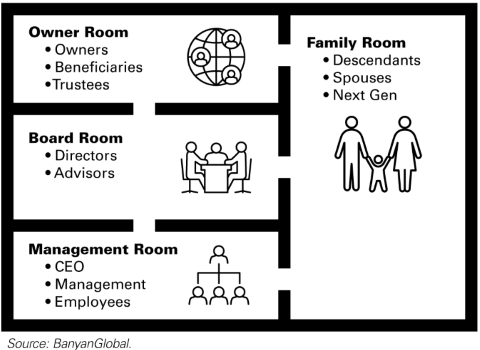
Josh Baron and Rob Lachenauer from Banyan Global, renowned global advisors for family businesses, developed the “four room” governance model and I believe it showcases a strategic and simplified approach to governance that is so useful for families.
Imagine your family business system as a home with four rooms: an Owner room, a Board room, a Management room and a Family room. To be clear this model can work with any type of family structure; where there is still an operating business(es), where the family “business” may be a professional Family Office or with a less formal capital structure.
The value of building governance around the four room model is that it defines rules and boundaries around decision making, who belongs to what room and how the rooms interact.
The Owner Room
The Owner room comprises the current owners of the family business(es), think of it as the shareholders meetings and owners council meetings. This room may start with the founder(s) and over time include spouses, next generation owners and even future owners in a preparatory capacity.
The key decisions that are made in the Owner room are:
Ownership transfer, sale and succession,
Major structural decisions (e.g. capital raising, sale, listing),
Defining priorities across growth, liquidity and control,
Appointment of the board,
Policies relating to family involvement in the business, and
Any other decisions that are deemed so critical to the success of the business, only the owners should make them.
The key governance documents that guide the Owner room are:
Owner Strategy statement - articulates the purpose, goals and guardrails for board and management to make decisions regarding trade-offs. This becomes more important with non-family CEO and executives.
Shareholders agreement - defines the legal rights and obligations between owners.
Owners Council Charter - sets out how owners engage and make collective decisions.
The Board Room
The Board room includes the directors of the business, and represents the owners’ interests to management, sitting between the Owners room and the Management room. As businesses grow, the inclusion of independent, non-family directors becomes increasingly important to bring objectivity, capability and external perspective.
The key decisions that are made in the Board room are:
Hiring or firing the CEO, and setting the KPIs and compensation for this role,
Planning management succession, including consideration of family and non family members,
Providing approval for business strategy and significant decisions such as acquisitions and loans,
Setting annual dividends with consideration of the Owner Strategy and business performance, and
All standard directors duties such as regulatory and fiduciary responsibilities.
The key governance documents that guide the Board room is the Board Charter, which defines the roles, responsibilities and authority of the board, including its relationship with owners and management.
The Management Room
The Management room is responsible for executing strategy and operating the business. It includes both family and non-family executives. The delineation of this room from Owners and the Board is important over time to empower decision making (with guidance from these rooms) and ensure those operating the business are closest to the management decisions.
The key decisions that are made in the board room are:
Recommending strategy to the Board
Operating the business
Hiring and firing
The key governance documents that guide the Management room are:
Board approved strategy
Board approved annual budget
Delegation of Authority
Organisational structure and roles
Operational policies such as risk registers, procedure manuals and performance frameworks
The Family Room
The primary purpose of the Family room is to enhance family unity and build family talent. All family members above a certain age can be part of the Family room, including spouses and next generation, at the discretion of the family.
There are two key structures in the Family room:
The Family Council: usually a smaller number of family members who represent the whole family. This may be defined by one member per branch of the family, one member per generation, or for smaller families, all members over a certain age. The Family Council may have specific mandates across development of the next generation, regular communication such as newsletters and integration activities such as a family retreat.
The Family Assembly: includes all family members of any age and is a reunion or retreat for the family, occurring every year or so. The assembly can range from a single day with a straightforward agenda and informal catering, to a week-long gathering with a more structured program of activities.
The Family Council will have a charter providing the mandate and how members are elected, with the Family Assembly typically a template agenda to ensure key items are covered. Additional governance documents are policies defining family communication, education, succession and code of conduct.
Interaction of the four rooms
As shown in the diagram above, the Family room runs adjacent to all other rooms indicating the importance of maintaining family influence, unity and developing family members who would like to join other rooms.
Furthermore, many family members can sit in many or all rooms, which supports the concept that clear delineation of the decisions and responsibilities across these rooms is fundamental to success. Wearing the right “hat” in the right room will focus decision making. Developing a decision matrix by room and decision type will guide clarity.
It is important to clearly map the key decisions that link each room. For example, the Owner room may determine that the CEO must be a family member; the Board reflects this in its appointment decisions and Management operates under the leadership of that family CEO.
A final word on complexity
This may sound like a complicated way of thinking about what could potentially be a simple family and business structure. However, even where a G1 founder remains active across all four rooms and the business is wholly family-owned, separating decisions in this way creates clarity and builds the processes needed to navigate succession, the involvement of spouses, the next generation and the increasing complexity that inevitably follows. Where G2 adults start working in the business, they marry and have children, the founding generation want to retire but still remain active decision makers, this clarity is increasingly invaluable.
Conclusion
Thoughtful governance does not need to be overly complex, but it does need to be intentional. Taking the time to define how decisions are made, who is involved and how the family remains aligned can significantly strengthen both the family and the enterprise over time.
